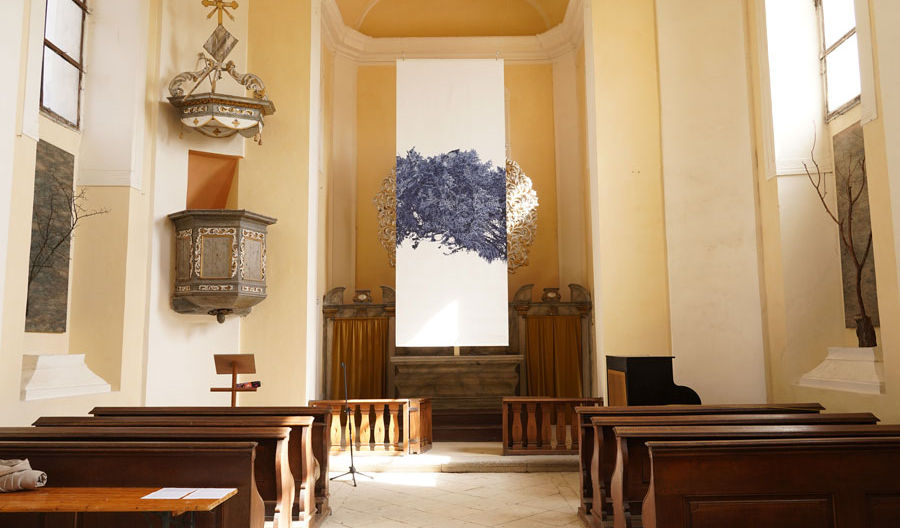
BROTHER TREE
Jaroslav Anděl, Lenka Falušiová, Miloš Šejn
Church of St. Nicholas and St. Anne in Telce, Czech Republic
2026
curator © Jaroslav Anděl
The impulse for the exhibition Brother Tree at the Church of St. Nicholas and St. Anne in Telce came from Lenka Falušiová, who presented her work here last year alongside Miloš Šejn in the exhibition Places of Dreamers. This year, Lenka expressed her wish to exhibit together with me and Miloš, as all three of us share an interest in the theme of the tree. It seems that the exhibition takes place in the right setting. The organizers of the exhibition—namely Anna Ježková and Luděk Šára, and their association Krajina domov komunita—care not only for the church in Telce, but also for the trees surrounding the area.
Brother Tree also has a historical predecessor in the exhibition Tree, which I prepared together with Antonín Dufek for the Cabinet of Photography of J. Funke at the Brno House of Arts in 1978. Alongside works by the classics of Czech photography—Josef Sudek, Jaromír Funke, and Eugen Wiškovský—it included photographic documentation of actions by Petr Štembera, Peter Bartoš, Peter Thurzo, Dezider Tóth, Jan Steklík, Vladimír Ambroz, Miroslav Halas, Ivan Kafka, as well as one of my own actions or a conceptually conceived work by Jiří Valoch and Dalibor Chatrný.
In the introductory text to that exhibition, I referred to the French philosopher Gaston Bachelard and his idea of the continuity between contemporary and the most ancient poetic images of the tree. This idea has lost none of its relevance, and therefore I allow myself to introduce the exhibition Brother Tree with the opening paragraphs of my text written forty-eight years ago.
There, within the trees, by a strange power,
a spell lies hidden…
— Joseph von Eichendorff
In recent times, the tree has become one of the objects of environmental protection. It has become evident that even solitary trees in the open landscape and in the immediate vicinity of human life must be preserved. For tens of thousands of years, the environment in which humans lived was formed predominantly by plant vegetation. According to some views, the sudden absence or scarcity of trees may have a negative impact on the human psyche.
Yet, as some of the works in this exhibition demonstrate, the tree is not merely an object of ecological concern—it may also serve as its symbol, becoming an embodiment of environmental values. This fact has deeper roots. The tree belongs among the oldest motifs in visual art and literature; its image runs through the entire cultural history of humankind. Since time immemorial, the tree has been one of the central themes of human imagination.


PLACES OF DREAMERS
Lenka Falušiová & Miloš Šejn
Church of St. Nicholas and St. Anne in Telce
2025
curator © Jaroslav Anděl
There are places that seem to hold a secret power over us—places that enchant, that draw us in. They are places of depth, where one may discover oneself, yet just as easily become lost. Often, these are realms governed by the elements: water, fire, earth, and air—sometimes singly, sometimes in pairs, sometimes in triads. They are sites that stir the imagination, that invite reverie, where one perceives the living web of connection between all things. Dreamers are those with the sensitivity to recognize such places, to enter into their depths. And though each of us carries within a fragment of the dreamer, and though almost any place may become a place of reverie, it seems that certain sites are, by their very nature, destined for it.
Some artists belong to this lineage of dreamers, drawn to particular places and elements, as the French philosopher Gaston Bachelard once so piercingly described. Lenka Falušiová is such a dreamer of the forest, which has remained for her a primal source of inspiration, encoded since childhood in the Jeseníky mountains. For her, the forest is an image of the living, breathing world—one in which human, animal, and plant exist side by side, on the same plane. The tree, that ancient cosmological symbol, rises again and again in her works. “Trees are the guardians of the forest,” she says. Yet Lenka is not a Bachelardian dreamer of any one of the four elements; she is, rather, a dreamer of light. If Bachelard turned to the verses of great poets to reveal the imagination of the elements, Lenka’s works may serve as a path toward the phenomenology of light itself.
Miloš Šejn, by contrast, is a dreamer of the earth. His place of initiation is Zebín, a volcanic hill near Jičín, where he has lived since youth. Zebín shaped his first painterly gestures and guided his further artistic journey toward ever more direct forms of contact with chosen sites—whether in the form of imprints of terrain, the gathering and testing of natural pigments, or performative acts of intervention. And although over the decades Miloš has engaged with other elements—water among them—it seems to me that his imagination feeds most deeply on the forces of the earth. Thus, as I linger over his works, the word chthonic comes insistently to mind. From the Greek chthōn, earth, it names what belongs to the soil, the subterranean, the underworld.
The work Delimitation of Space with Fire (1982) brings together two archetypal images of humankind’s earliest imaginings: fire and the cave. Here, fire recalls not only our primeval intimacy with flame but also the cataclysmic history of the earth itself, bound to volcanic upheaval. Šejn’s cave is a chamber of reverie, opening into the depths of human history as well as into the deep time of the earth.


